The liberalism that has long shaped international trade and Swiss economic policy is coming under pressure. A look at recent developments in the United States makes this clear. Between growing faith in the state, political polarisation and criticism of globalisation, free-market arguments are losing ground. The once self-evident alliance between business and conservative politics no longer holds the same weight. At this year’s SwissHoldings General Meeting, the political changes were analysed and the future of liberalism was discussed. It became clear that liberal economic policy needs to be renewed, broadly anchored and actively defended against domestic and foreign political pressure.
Open markets, entrepreneurial freedom and a lean state formed the basis of policies that have promoted growth and prosperity. However, this model of success is increasingly being challenged. The resurgence of state intervention, national isolationist tendencies and growing scepticism about free trade and deregulation make it clear that economic liberalism is under scrutiny in Switzerland and internationally.
A strong location needs economically liberal majorities
Multinational companies are clearly feeling the effects of the current geopolitical and economic upheavals. Abroad, they are increasingly confronted with political instability, unpredictable dynamics and highly complex regulations. In Switzerland, they continue to benefit from the stability and reliability of the political system, but even here, liberal economic arguments and good framework conditions are coming under increasing pressure. This makes it all the more important to nurture and further develop existing location factors in a targeted manner. At the same time, in view of growing international pressure, reforms must be tackled where Switzerland itself can act. However, this requires that political majorities for liberal economic policy can continue to be secured in the future.
A liberal future
Against this backdrop, the General Assembly discussed what businesses and politics need to do together to strengthen liberal economic policy. In his keynote speech, Federal Councillor Guy Parmelin explained what makes the Swiss model so successful and how it can be continued. Sebastian Ramspeck, SRF’s international correspondent and host of #SRFglobal, provided an overview of the current global turmoil and put it into context. In the panel discussion that followed, Prof. Dr Silja Häusermann, University of Zurich, Prof. Dr Andreas Bohrer, Lonza Group AG, and Thierry Burkart, Member of the Council of States, FDP Switzerland, explored the topic in greater depth and concluded that liberal economic policy is facing new challenges. However, it is of great economic importance to meet these challenges for the benefit of Switzerland and its population. This requires a joint effort.
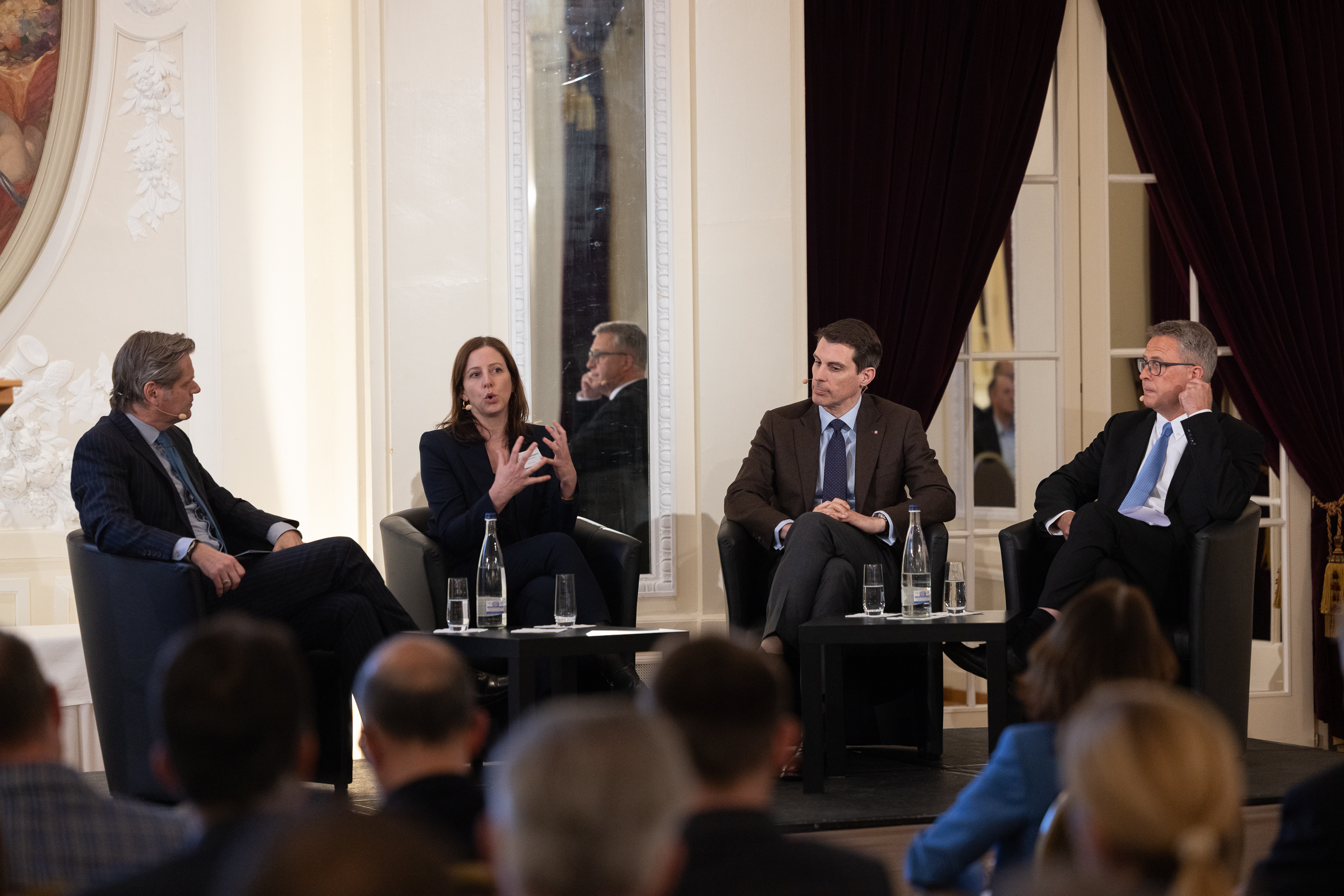
On the podium, the topic was discussed from different perspectives.
After the substantive part of this year’s General Assembly, there was a change in the presidium. Dr Annette Luther, who has chaired the association for the past two years, is handing over the office to Prof. Dr Andreas Bohrer. We would like to express our sincere thanks to Dr Annette Luther for her work and wish Prof. Dr Andreas Bohrer every success in his new position.
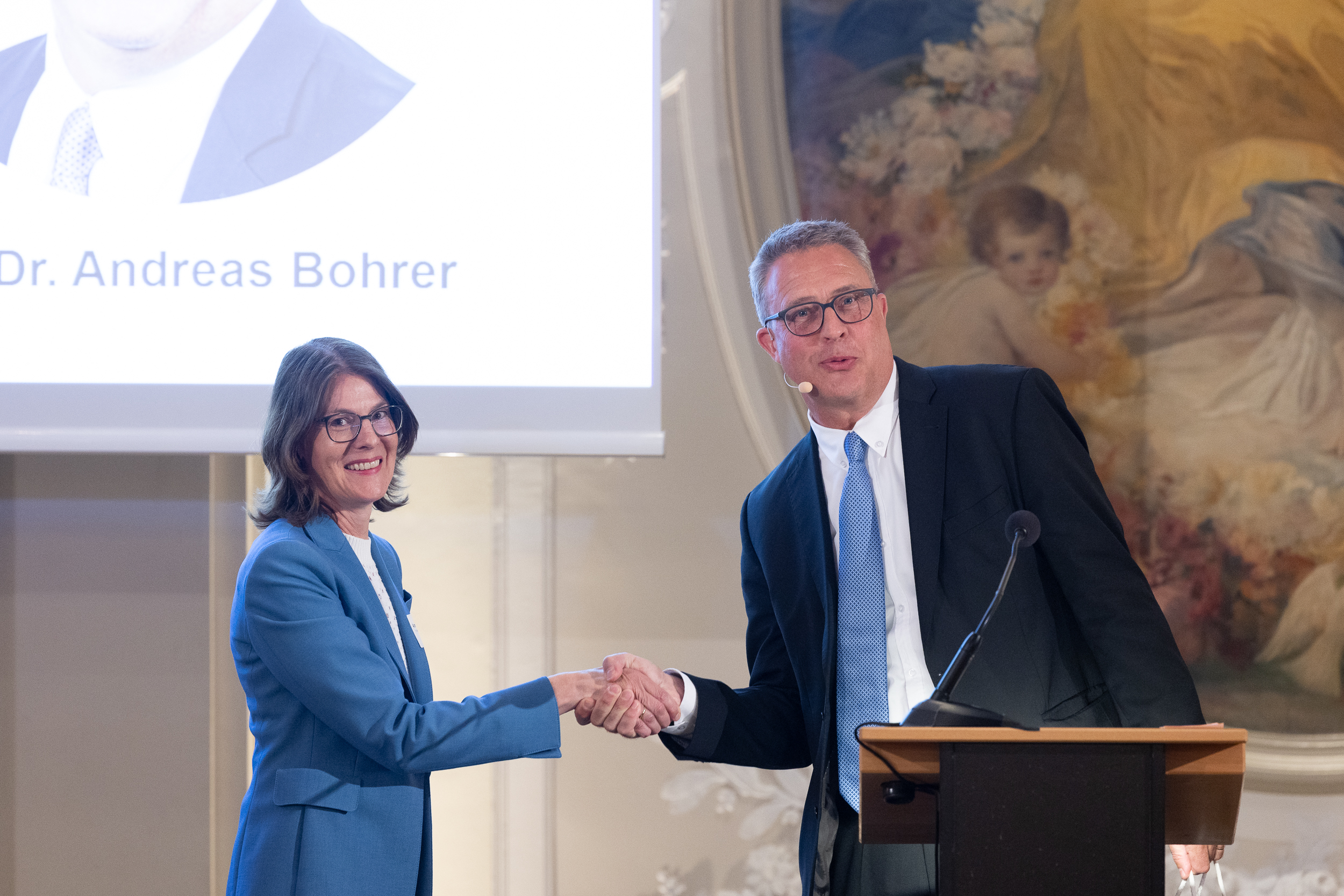
Dr Annette Luther hands over the presidency of SwissHoldings to Prof. Dr Andreas Bohrer.
Dr Gabriel Rumo, Director of SwissHoldings, concluded the event by saying that ‘especially in a changing environment, our association can play an important role in communicating Switzerland’s model of success in an understandable way and making liberal economic policy fit for the future’.
For further information:
Julia Besnier | Head Communications & Public Affairs
julia.besnier@swissholdings.ch | +41 31 356 68 60